Issue 2: The Edge of Motion
Speed, movement, and the art of chasing moments before they vanish.

Time bends when you move faster than the world around you. Every second is a line drawn, a story in motion, a memory before it fades
Opening Manifesto
Speed is more than a number.
It’s the blur of light against asphalt,
the hiss of fabric cutting through air,
the echo of footsteps in an empty alley.
We chase motion because it refuses to wait.
Because the second you see it,
it’s already gone.
A rider leans into the curve.
A model disappears behind the curtain.
A wave collapses back into the sea.
Motion is memory before it disappears.
And this issue is our attempt to hold it
if only for a moment.
Arlen: Issue 2 — The Edge of Motion
In these pages, we archive speed, transience, and the adrenaline of vanishing moments. From racetracks to runway walks, street corners to soundwaves, this is a study of movement — how it shapes culture, style, and the way we remember.
Engines as Heartbeats
Motorsport isn’t about who crosses first.
It’s about the blur between life and risk.
Every lap is a negotiation with mortality.
Every corner is a promise you might not keep.
The Isle of Man TT — riders threading the needle between stone walls at 320 km/h.
Senna, speaking of racing as if it were religion, then vanishing at Imola.
Machines scream, and in their noise, we find silence:
a moment where speed becomes the only language.
Engines don’t just power. They pulse.
They turn asphalt into a stage,
drivers into dancers,
and accidents into myths.
Motorsport is not sport. It’s choreography in danger’s shadow.
A ritual of acceleration.
The heartbeat of culture at full throttle.

Movement is the language of survival and expression.
From the roar of engines on tight corners to the silent sprint through forgotten alleyways, this issue dives into speed the beauty, the chaos, and the people who live at the edge of it.

Artyon Senna
in
1992-93

Clothes That Refuse to Stand Still
Fashion isn’t about fabric.
It’s about the way fabric moves.
The drape of Margiela’s oversized coats.
The collapse of Rick Owens’ silhouettes against the wind.
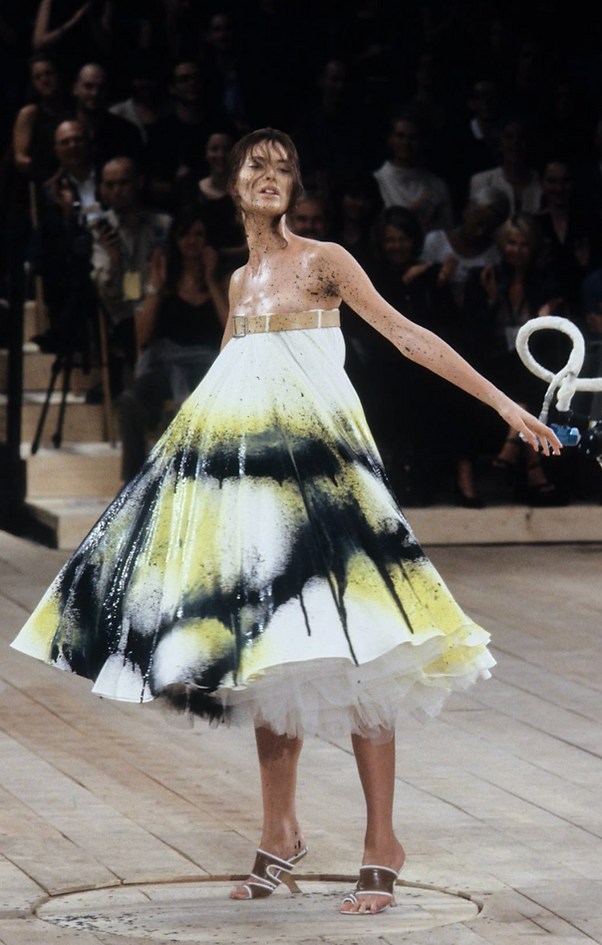
The violence of McQueen’s spray-painted dress —
a garment born in seconds,
never still long enough to become ordinary.
Runways are not catwalks.
They’re highways.
Every step, a negotiation with gravity.
Every sway,
a reminder that clothes only exist when they’re in motion.
A jacket on a hanger is just material.
A jacket in the street is a weapon, a signal,
a manifesto in fabric.
Fashion becomes alive in movement.
And when the body stops, the garment dies.


Willem Dafoe during
'VILLAINS RUNWAY'
Prada fall 2012
Rick Owens ss25
McQueen’s spray-paint dress
Noise That Moves Us
Music is the fastest vehicle we know.
It moves without wheels, without bodies,
slipping through walls, lungs, and veins.
Think of jungle’s breakbeats in London basements —
how they bent time into staccato rhythms.
Or Detroit techno, machines teaching humans how to dance.
Or the chaos of Playboi Carti’s live shows,
where bodies crash against each other,
as if the crowd itself is the instrument.
Sound is movement because it refuses stillness.
A note can’t be frozen.
A bassline can’t be held.
It exists only in transit, in vibration, in the instant before silence.
Music is motion made audible.
It leaves no artifact but memory.
And maybe that’s why we keep chasing it.

Playboi Carti X Travis Scott

THE QUEENS at 1985 live aid

Ed Sheeran X Eminem in Detroit
UNSEEN INFLUENCE: The Art of Refusing Permission
KYD / Kill Your Dreams
KYD (Kill Your Dreams) is one of those brands.
Born in India’s underground,
its name isn’t defeatist —
it’s defiance.
A statement that dreams are only real once you kill them,
strip them down, and rebuild them as something harder, sharper.
In a culture obsessed with hype,
KYD doesn’t scream.
It whispers.
And somehow, the whisper carries further.


KYD is not just designing clothes, but proposing an attitude: raw, agile, unpolished yet precise. For Issue 2, we sat down with the team behind KYD to decode their process, their philosophy, and why speed and stillness coexist in their universe.
1. What inspires the rhythm or emotion behind your work?
It’s the noise I grew up around Bollywood reruns on TV, torn film posters on street walls, old family albums, and the constant pressure to behave, blend in, be grateful. My rhythm comes from resisting that. I chase discomfort, distortion, and emotional residue not neat endings.
2. Are there certain ideas or stories you always return to?
Yes the stories we pretend not to see. Posters half-ripped off walls, eyes torn out from old magazines, headlines covered in dust. The faces that used to be everywhere, now fading. I keep going back to the idea that beauty and memory are both disposable celebrated today, forgotten tomorrow. And I’m drawn to that moment right before the forgetting happens.
3. How do you want people to feel when they engage with your work?
A little exposed. Like the piece knew something about them before they were ready to admit it. I want it to hit that sweet spot between nostalgia and discomfort where you’re both cringing and holding on tight. It’s not meant to be liked. It’s meant to stay with you like a line from an old movie you can’t forget.
4. What image, texture, or word defines your creative state right now?
Bubble wrap. It looks like protection, but it’s temporary. It muffles, but doesn’t stop harm. It’s fragile. It’s fake safety.

5. If your art could whisper something to the world, what would it say?
Your dreams are lying to you


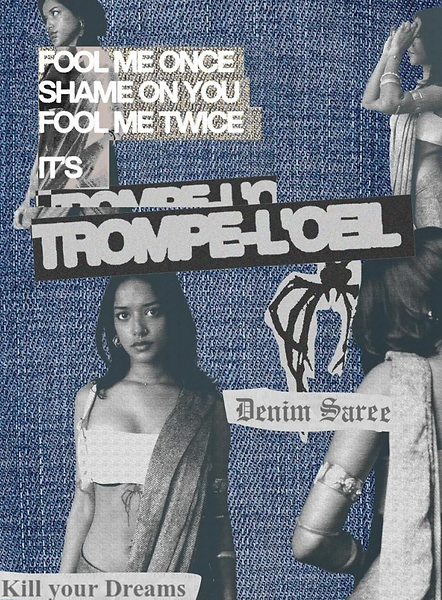


Proof that speed in fashion doesn’t always mean loudness, sometimes it means precision.
The Underground Shelf
Some books don’t just sit on shelves — they live in the bloodstream of culture. They pass hand to hand, whispered about in dorm rooms, designer studios, basements, and backstages. They don’t belong to the mainstream canon but to the underground circuit, shaping how subcultures think, dress, and dream.The Underground Shelf isn’t about what you’re told to read — it’s about the texts that built movements, rewired style, and left fingerprints on everything from photography to runway collections
Here are the 10 Books That Shaped Culture
1. The Crowd – Gustave Le Bon
The psychology of masses, influence, and power. A handbook for understanding hype before hype existed.
2. AmericanPsycho – Bret Easton Ellis
The sharpest satire of consumerism, Wall Street culture, and obsession with surfaces — referenced endlessly in fashion.
3. Valley of the Dolls – Jacqueline Susann
Fame, beauty, addiction — a cult novel that still bleeds into pop culture aesthetics.
4. Simulacra and Simulation – Jean Baudrillard
The text behind The Matrix — a bible for anyone navigating hyperreality, media, and spectacle.
5. Wuthering Heights – Emily Brontë
Gothic obsession, raw emotion, and the romanticism that still inspires designers from McQueen to Ann Demeulemeester.
6. Please Kill Me: The Uncensored Oral History of Punk – Legs McNeil & Gillian McCain
Punk’s bible. Chaos, noise, style, and rebellion — straight from the mouths of those who lived it.
7. The Philosophy of Punk – Craig O’Hara
Not just music — but an entire subcultural manifesto on DIY ethics, politics, and identity.
8. Less Than Zero – Bret Easton Ellis
Decay and emptiness in 1980s Los Angeles — aesthetics of alienation that still echo in fashion campaigns today.
9. Lipstick Traces – Greil Marcus
A cultural archaeology of punk, Dada, Situationists — the link between art movements and music rebellion.
10. Highsnobiety: The Incomplete Highsnobiety Guide to Street Fashion and Culture
From underground to mainstream — documenting the global rise of streetwear and how it rewrote fashion codes.
Join the Archive
Arlen is built with the voices, visions, and stories of those who refuse to stand still. If you’re a creator — writer, artist, photographer, designer, or thinker — we want to see your work. Submit your ideas, visuals, or projects to arlenmagazine@gmail.com and become part of the next issue.
For readers who want more: subscribe to Arlen and never miss a page. Culture doesn’t wait — neither should you.
The Last Word
Culture never stands still. It moves — fast, reckless, sometimes silent, sometimes loud enough to break glass. The Edge of Motion has been our attempt to capture that fleeting blur: the roar of engines on forgotten tracks, the cut of fabric turned into armor, the words that outlive their authors, the brands that refuse to play by the rules.
This is not an ending, but a checkpoint. What you’ve read, seen, and felt in these pages is only a fragment of what’s out there. Tomorrow, culture shifts again — new voices rise, old myths return, speed collides with stillness.
Arlen is here to archive, to disrupt, to remind. And as we close this issue, we leave you with one thought:the edge of motion is where history is written.
Until the next one.— Arlen Magazine, Issue 2